BSEC-URTA Shares Its Regional Experience and Perspective on Intercontinental Connectivity at a UNESCAP Special Event
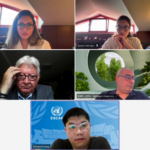
BSEC-URTA Expert Elif Nuhoğlu, at the invitation of the United Nations Economic and Social Commission for Asia and the Pacific (UNESCAP), shared the Union’s field experience in Europe–Asia transport, its work on border-crossing facilitation and digitalisation, and its perspective on future intercontinental cooperation at the “Subregional Capacity Building Workshop on Advancing Sustainable Transport Corridors to Strengthen Inter- and Intra-regional Connectivity”, held in Yerevan on 14–15 September 2026

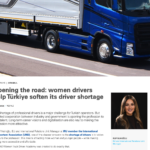
The UNESCAP special event also examined the “UND Women Truck Driver Academy”, which successfully combines women’s vocational training with public support and private-sector employment in Türkiye, as a regional good-practice model that could be adapted to the needs and conditions of Asian countries.
BSEC-URTA Meets with Representatives of Countries in the Region, International Organisations and Academia
Focusing on the Asian Highway Network and its connections, the event brought together representatives of member States, international organisations, development institutions and BSEC-URTA as a private-sector representative. It also examined the operation of East–West corridors linking North and Central Asia with Türkiye and China. Sustainable infrastructure, border-crossing facilitation, digitalisation and smart technologies were considered alongside landlocked countries’ access to international markets and the predictability of transport operations.
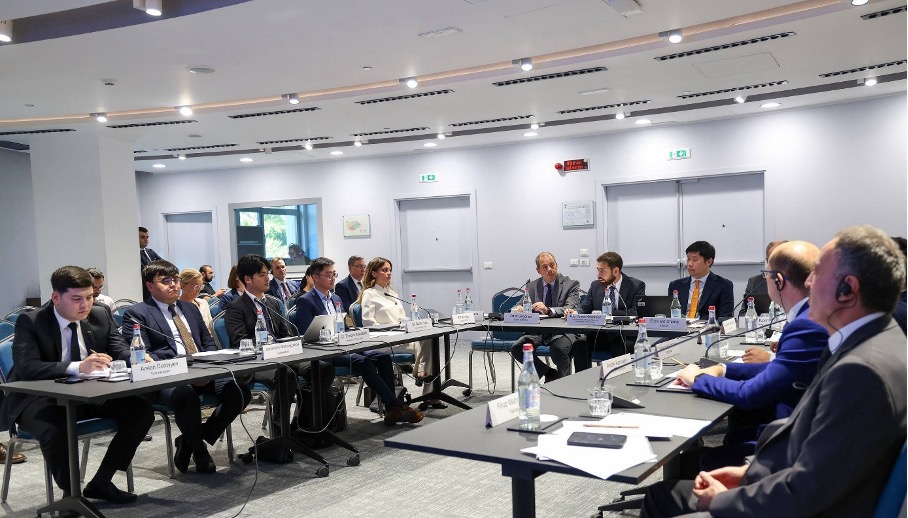
The programme featured UNESCAP’s framework for sustainable road transport corridors, regional guidelines and pilot project work, together with the approaches of the United Nations Economic Commission for Europe (UNECE) and the Eurasian Economic Commission (EEC) to operational challenges in international road transport.
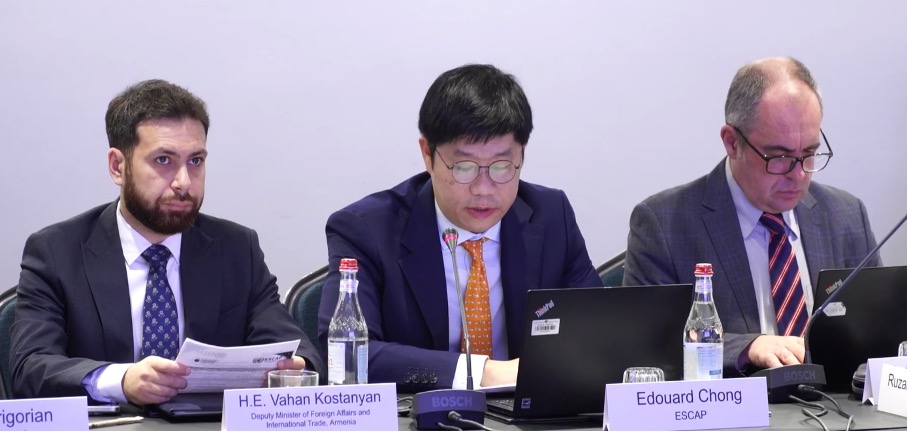
The European Bank for Reconstruction and Development (EBRD) focused its presentation on mobilising public and private investment for sustainable transport corridors. The United Nations Office of the High Representative for the Least Developed Countries, Landlocked Developing Countries and Small Island Developing States (UN-OHRLLS) addressed the implementation of the Awaza Programme of Action.
In the session on new technologies and innovation, the International Road Federation (IRF) discussed applications of artificial intelligence in the road sector; the University of Tokyo examined freight transport systems being transformed by logistics innovation and automation; and Tongji University explored how real-time logistics information sharing and platform integration can improve corridor efficiency. Country sessions were dedicated to national transport plans, actions and priorities for 2026–2027 and the medium term.
BSEC-URTA Connects Its Field Experience and Regional Role in Europe–Asia Transport with International Cooperation
Our presentation, “From Regional Cooperation to Integrated Freight Connectivity: BSEC-URTA’s Operational Experience, Transport Facilitation and Potential Digital Cooperation”, highlighted the Union’s experience from real transport operations across different countries and potential areas for future work.
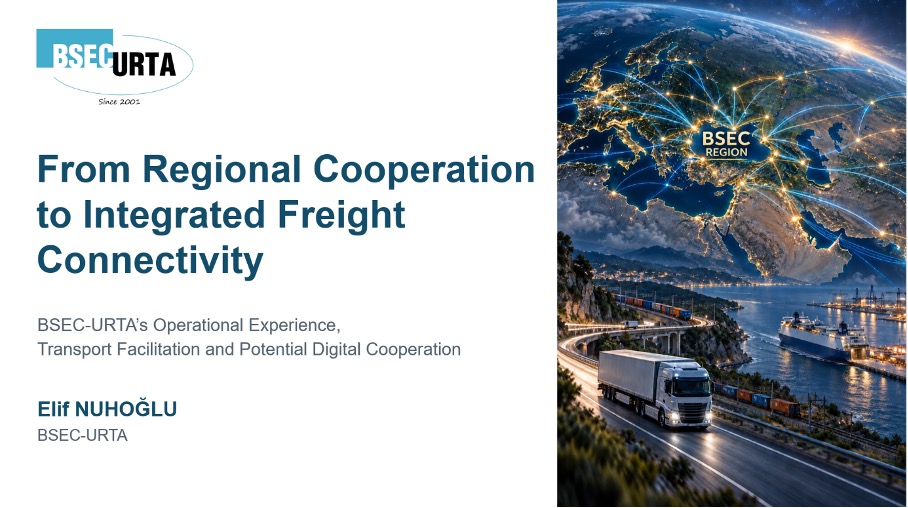
Participants were introduced to the operational experience of the BSEC-URTA network, which brings together 16 member organisations from 12 countries and eight observer organisations, representing more than 111,000 hauliers operating over 1.2 million freight vehicles.
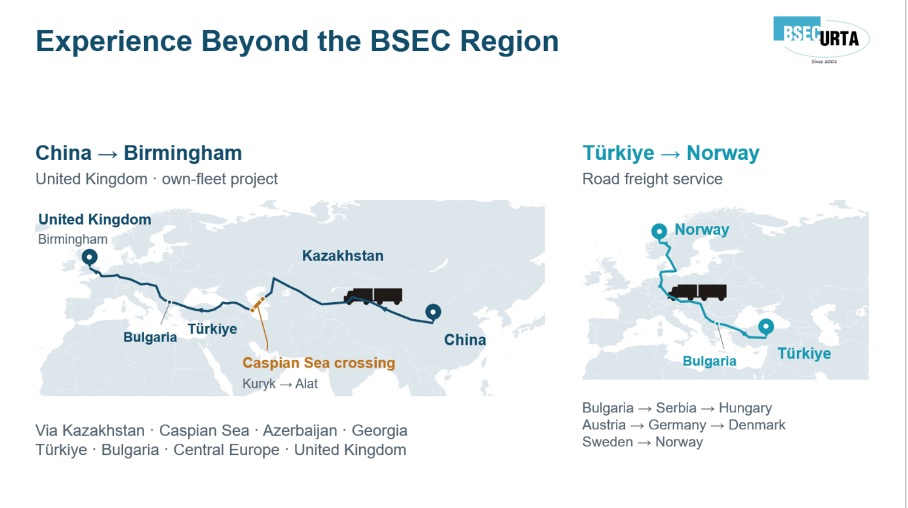
Examples of China–United Kingdom and Türkiye–Norway operations undertaken by hauliers within our member organisations illustrated how the Union’s field experience extends beyond the Black Sea region to transport chains connecting Asian markets with Western and Northern Europe.
However, particular emphasis was placed on the need to consider infrastructure investment and day-to-day operations together in corridor planning, as a delay at a single point in the operational chain can generate additional costs and inefficiencies throughout the logistics supply chain.
BSEC-URTA Shares Its Perspective on Border-Crossing Facilitation and Intercontinental Digital Cooperation
The Union’s work on border-crossing facilitation was illustrated through the BSEC Permit, follow-up on problems encountered by hauliers, and site assessments at border crossings. Examples from Kipi, Leușeni–Albița and North Macedonia–Serbia border links were used to share BSEC-URTA’s experience of public–private coordination and improvements to operational procedures.
Opportunities for cooperation to improve data continuity along Europe–Asia transport chains and strengthen intercontinental digital connectivity were presented alongside BSEC-URTA’s perspective on future cooperation. The discussion examined the potential for shipment information prepared in Asia to be reused during European transport stages and for repetitive documentation procedures to be reduced through e-CMR pilots, eFTI readiness and the reuse of freight transport data across different systems.
From Training to Employment: The UND Women Truck Driver Academy Model
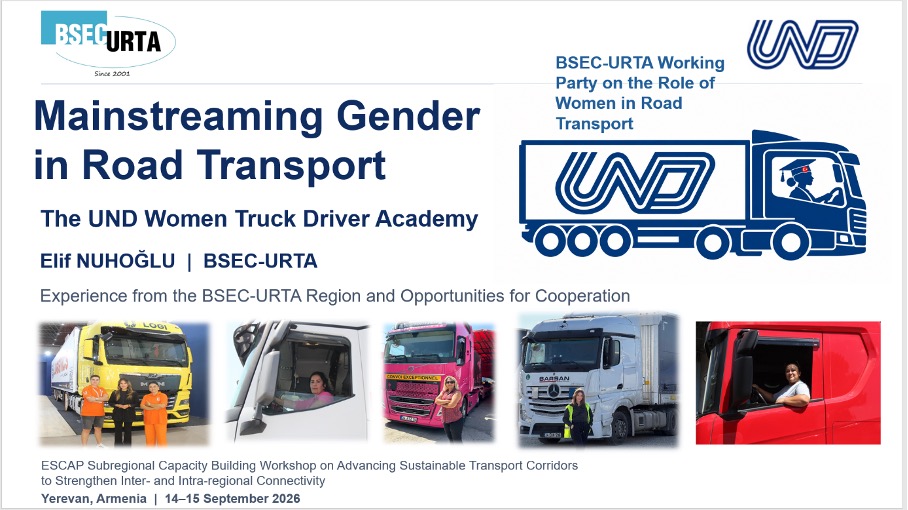
Our presentation, “The UND Women Truck Driver Academy: Experience from the BSEC-URTA Region and Opportunities for Cooperation”, shared the training-to-employment model and practical experience of the Academy, established by the International Transporters’ Association (UND), one of the Union’s member organisations in Türkiye.
Particular attention was given to how institutional support from Türkiye’s Ministry of Transport and Infrastructure, the Ministry of Labour and Social Security and the Turkish Employment Agency (İŞKUR) is combined with training and cooperation with employers. Beyond entry into the profession, the discussion also addressed retention, safe working conditions and the hygiene and rest needs of women drivers.
The potential to adapt the Academy’s model to local needs and institutional conditions in Asian countries as a basis for similar initiatives was also highlighted as an avenue for regional cooperation. The model combines training, public support and employment.
We extend our special thanks to the UNESCAP Transport Division and Mr. Edouard Chong for their kind invitation and for providing the opportunity to share our Union’s experience with international stakeholders.